
Integrated Distributed Fibre-Optic Pipeline Monitoring Solution (Φ-OTDR + Interferometric Hotspots + DTS)
1) Objectives & scope (oil & gas / refined products / gas distribution / water trunk mains)
Objective. Deliver along-ROW early leak detection with precise localisation, third-party interference (TPI) and geohazard disturbance recognition, detectability of micro-leaks/low-rate releases, and round-the-clock operation with low false-alarm rates, integrated to SCADA/RTU for actionable dispatch.
Scope. Buried, above-ground and subsea sections; valve stations, facilities and crossings; urban water trunk lines and utility galleries. The system adopts a layered configuration—Φ-OTDR corridor + interferometric hotspots + DTS thermal corroboration—to balance long-range coverage and high sensitivity at critical points.
2) Sensing principles & technology selection
2.1 Phase-sensitive OTDR (Φ-OTDR; coherent Rayleigh DAS)
Principle. External vibration perturbs fibre length/refractive index; the backscattered Rayleigh phase is demodulated coherently into an intensity time series and mapped to distance via round-trip time. Spatial resolution scales with optical pulse width ΔT:
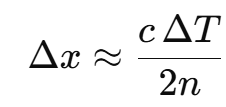
with cc the speed of light and nn the group index (e.g., 50 ns → ≈ 5 m). Suitable for multi-event, long-corridor monitoring; detection range and SNR are enhanced via Raman amplification and spatio-temporal reconstruction.
2.2 Sagnac interferometer (linear/dual-loop/Faraday-mirror variants)
Principle. Counter-propagating beams experience differential phase under local perturbation; the fundamental response peaks at a “zero-frequency” operating point. Leak distance RR relates to the modulation frequency fm by:
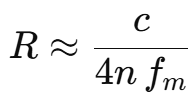
enabling position inversion from the measured fm Linearisations (dual Sagnac, 3×3 couplers) mitigate reciprocity, extend dynamic range and improve localisation accuracy.
2.3 Mach–Zehnder (M-Z) interferometer
Principle. An optical path-difference induces a phase term Δϕ(t) between arms, giving

with high response bandwidth and fine localisation; multi-point operation uses orthogonality (dual M-Z / hybrid layouts).
2.4 Distributed Temperature Sensing (DTS)
Principle. Leaks present thermal signatures through adiabatic expansion cooling, phase change and convection, observable as temperature steps or slope breaks on a quasi-stable background; for district heating/thermal pipelines/hot oils—or water mains with strong seasonal contrast—DTS provides thermal evidence to corroborate Φ-OTDR events.
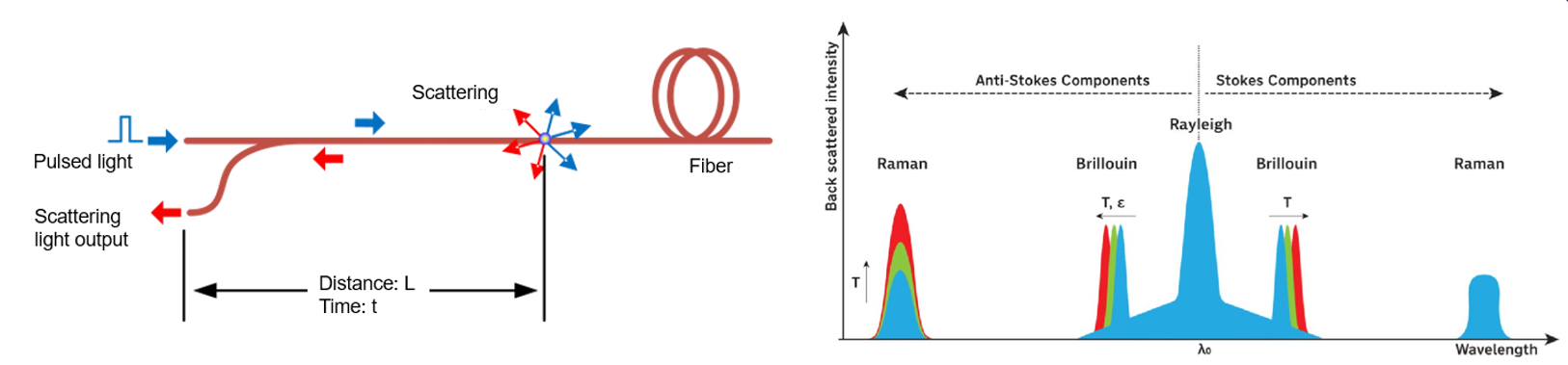
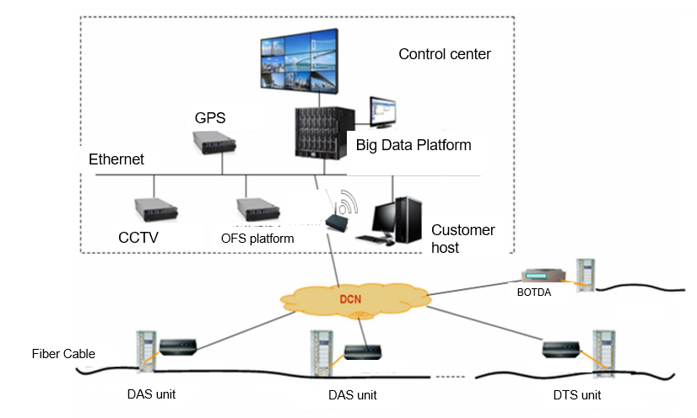
3) System architecture (“corridor coverage + hotspot gain + station integration”)
· Corridor layer. Φ-OTDR as the primary channel across the whole ROW; Raman-assisted spans for >100 km reach; sampling bandwidth tuned to typical leak/TPI spectral content (commonly 100–700 Hz).
· Hotspot layer. M-Z/Sagnac units at valves, urban/river crossings and geohazard segments as high-SNR sentinels and secondary confirmation.
· Thermal layer. DTS on thermally sensitive/liquid lines and trunk mains to provide heat-signature evidence at suspect locations.
· Platform layer. Edge–cloud processing, alarm stratification, GIS alignment and SCADA/RTU integration, with event replay and evidential packs (spectra, RMS tracks, cross-correlation localisation) for compliance/claims.
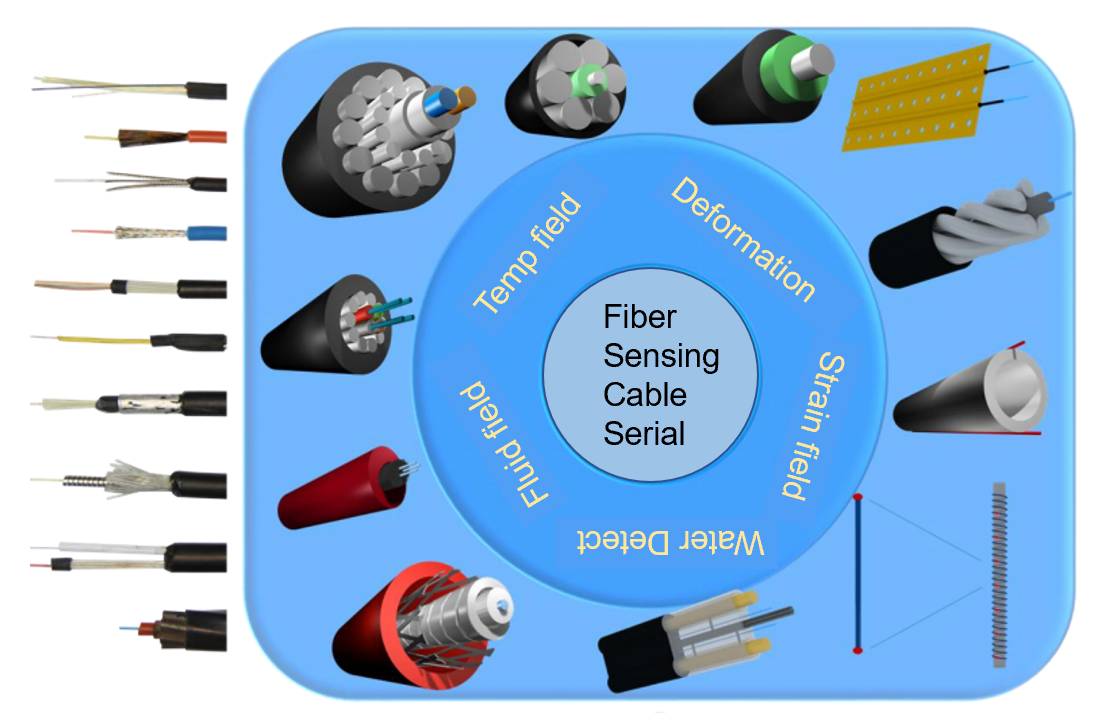
4) Cable placement & coupling (construction practice)
· Long-haul buried pipelines. Lay loose-tube cables within protective conduits along the ROW; install coupling anchors (ties/mortar slots) at bends/crossings to improve vibration transfer; use continuous tray/duct routing inside stations.
· Urban water trunk mains. Near-pipe trench placement/duct galleries with acoustic gain features to overcome urban noise and weak water-leak signatures.
· Subsea/near-shore. Wrap with companion/strap cables; deploy interferometric hotspots at valve skids/crossings; observe bend-radius and tensile handling limits.
5) Acquisition & processing (Detect → Localise → Classify → Evidence)
1. Pre-processing. Time-base and gain normalisation, banding/striping suppression, 2-D/3-D spatio-temporal reconstruction to raise SNR.
2. Detection. Short-window RMS, band-energy metrics (e.g., 100–150 Hz feature band), adaptive thresholds with background-drift compensation to yield candidate picks.
3. Localisation.
o Φ-OTDR: map via Δx=cΔT; refine multi-event centres using peak clustering and cross-correlation.
o Sagnac: estimate zero-frequency fm and invert R≈c/(4nfm)
o M-Z: phase-difference inversion; dual M-Z/hybrid layouts for orthogonal multi-point localisation.
4. Classification. Feature vectors (bandwidth, spectral shape, envelope modulation, duration, group-velocity coherence) to separate leak/excavator/vehicular loading/water-hammer/wave/anchor drag; a Φ-OTDR+M-Z hybrid demonstrably reduces FAR from ~25 % (single Φ-OTDR) to ~2 % in reported trials.
5. Evidence. Event replays, along-line band-energy sections, A/B tests (valve operations/steady-pressure), and DTS corroboration, outputting location + class + confidence.
6) Representative operating scenarios & tactics
· Pin-hole / slow liquid leaks. Low-frequency windows with long-window integration for weak continuous spectra; where applicable, confirm via DTS step/slope signatures.
· High-pressure gas pin-leaks. Broadband “whistle” peaks + group-velocity coherence; hotspot M-Z confirmation to suppress false alarms.
· TPI (excavators/piling). Mid-band, quasi-periodic spectra; post-localisation, trigger ROW geo-fence workflows.
· Subsea anchor drag/gear snag. Low-to-mid-band, long duration; hotspot interferometers at crossings/valve skids to elevate SNR.
7) Deliverables
An along-line event register (time–chainage–type–confidence–recommended action), layered GIS maps, and evidence packs (spectra/along-line energy/RMS heatmaps/cross-correlation localisation). Performance & compliance reporting includes baseline–monitor consistency, NRMS, FAR/MDR, localisation-error statistics, and system availability (≥ 99 %).
8) Key KPIs (contract/commissioning)
· Localisation error. Φ-OTDR ≤ ±10 m (typically 5–10 m, pulse-width and coupling dependent); Sagnac/M-Z hotspots ≤ ±50–100 m (as demonstrated in field deployments).
· False-alarm rate (FAR). Hybrid ≤ 2 %; single-channel Φ-OTDR managed at ≤ 10–15 % then reduced via fusion denoising.
· Detection latency. TPI seconds-class; continuous micro-leaks minutes-class (configurable).
· Coverage. Single-ended > 10–50 km; Raman-assisted spans to ~ 100 km effective range.
9) Implementation & O&M
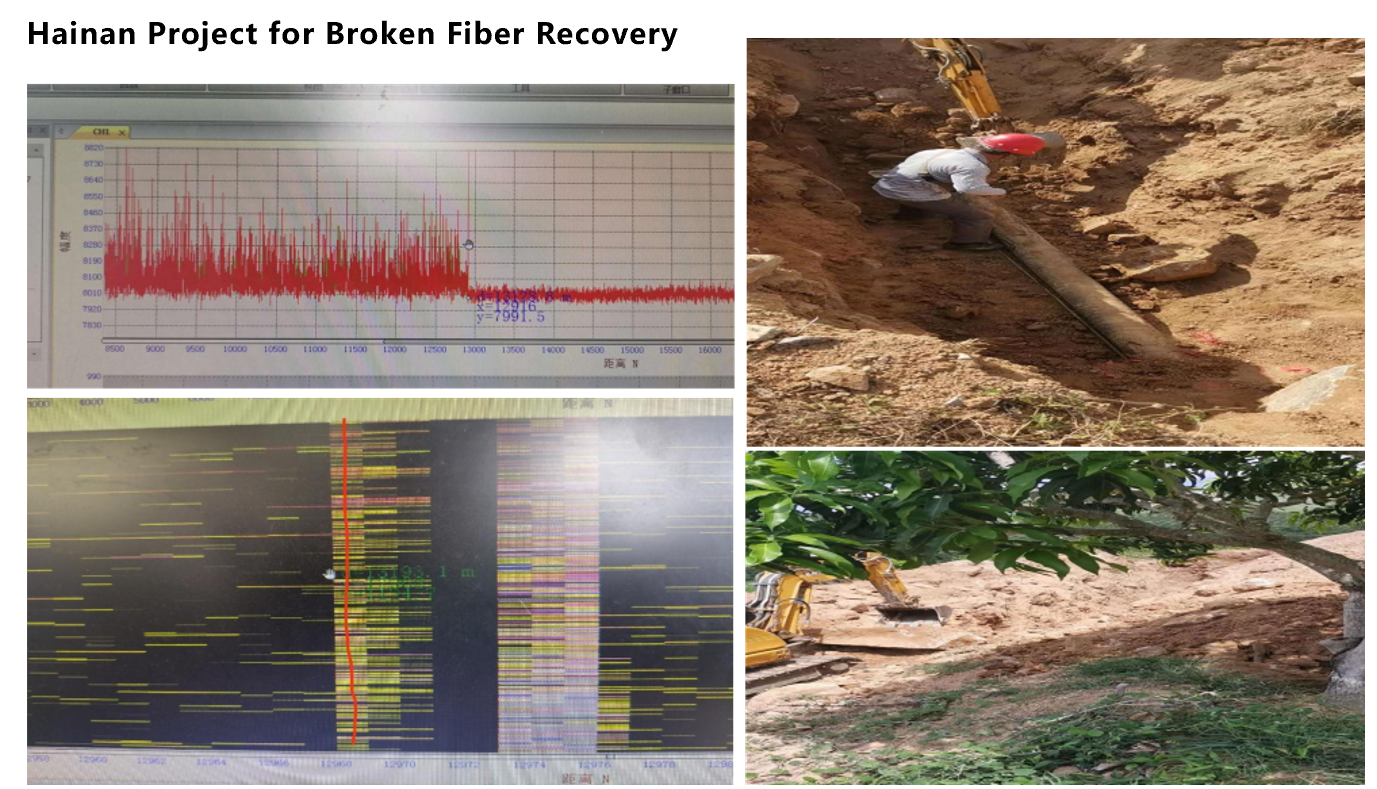
Feasibility/route walk-down → ROW & station inventory, coupling challenges, comms/power; System design → cable types, pulse/FS/spectral bands, hotspot nodes and DTS overlays; Construction & acceptance → coupling acceptance at critical segments (controlled excitation/vehicle A-B), baseline acquisition and threshold modelling; Trial run → scripted events (excavation/leak simulation/valve A-B), threshold calibration; Operations → periodic self-tests, version upgrades, feature-library/model online updates for low-FAR operations.
10) Risks & mitigations
Reciprocity/low-coupling blind spots → Sagnac linearisations and improved anchoring; hotspot densification. Complex ambient noise → multi-feature fusion and 2-D/3-D reconstruction to raise SNR; classifiers tuned for urban/gallery false-alarm reduction. Range–bandwidth trade-off → pulse optimisation + sectional acquisition + amplification; hotspot interferometers to reinforce high-frequency response. Concurrent multi-events → Φ-OTDR’s intrinsic multi-point capability; Sagnac/M-Z with dual-channel or hybrid layouts for de-congestion.
11) Value proposition (why a Φ-OTDR + interferometric + DTS hybrid is optimal)
Long reach with accurate localisation. Φ-OTDR provides corridor-scale, simultaneous multi-event localisation; Raman gain and reconstruction support 100 km-class spans. Low-FAR operations. Hybridising with M-Z/Sagnac materially lowers false alarms (reported reductions from ~25 % to ~2 %), enabling scalable, steady-state operations. Complete evidential chain. Mechanical/acoustic (Φ-OTDR/interferometry) plus thermal (DTS) triage meets safety/environment/insurance requirements for auditable compliance and claims substantiation.

 Prev
Prev
 Next
Next
 To list