
Fibre-optic 4D DAS-VSP Monitoring Solution
Scope and intent. This solution sets out an integrated, fibre-optic, time-lapse VSP (4D DAS-VSP) programme for CCUS/CCS and UGS settings, in which permanently installed, multi-well fibre arrays act as receivers and mobile or permanent seismic sources provide repeatable illumination, such that elastic-property changes within reservoir and caprock can be resolved through time to delineate plume geometry, leading-edge arrival, pressure–saturation evolution and any potential leakage pathways, while retaining sensitivity to subtle amplitude differences under gas-on-gas conditions typical of cyclic gas storage or re-pressurisation scenarios.
Objectives
To acquire a baseline (M0) and subsequent monitor surveys (M1, M2, …) with high source–receiver repeatability, thereby producing 4D difference volumes and attributes that map the advancing CO₂ or natural-gas plume and its migration direction (including up-dip drift along structural grain), quantify pressure communication and saturation change against stratigraphic architecture and seal capacity, and provide MRV-ready evidence of conformance and containment across the storage complex.
Survey design
Wellbores and fibre. Engineering-grade DAS cables are cemented outside casing in the injector and surrounding observation wells, with vertical coverage extending at least ~300 m above and below the injection interval to secure robust illumination across reservoir and seal; channel spacing on the order of 1 m, with a nominal gauge length / optical pulse width combination around 10 m / 4 m to balance SNR and vertical resolution, and acquisition sampling ≥1 kHz to accommodate 6–150 Hz linear sweeps.
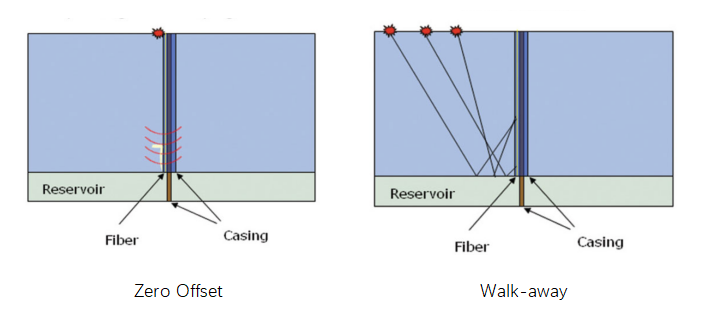
Sources and geometry. Baseline and monitor campaigns are shot with a mobile vibrator over a multi-loop grid, the source spacing and mesh density tuned to the target geobody scale (small 4D targets require denser source grids for illumination and repeatability); where higher temporal cadence is needed, permanent SOV and continuous offset-VSP can be layered in as a quasi-continuous surveillance channel.
Repeatability controls. Source–receiver geometry is held invariant, interrogator type and key parameters are kept constant, and, where instrument changes are unavoidable, a cross-instrument amplitude–phase matching and calibration workflow is executed to suppress acquisition-induced pseudo 4D differences.
Processing and cross-equalisation
Pre-processing. Depth registration, bad-channel culling, depth-window stacking and sweep correlation are performed with striping-noise suppression via 2-D spatial filtering, and source geometry is reconciled to DGPS control.
Wavelet handling. Deterministic deconvolution built on direct-P wavelet extraction broadens bandwidth and stabilises near-surface variability; Wiener matching filters are then applied to force monitor data towards the baseline wavelet, yielding waveform consistency for each monitor–baseline pair.
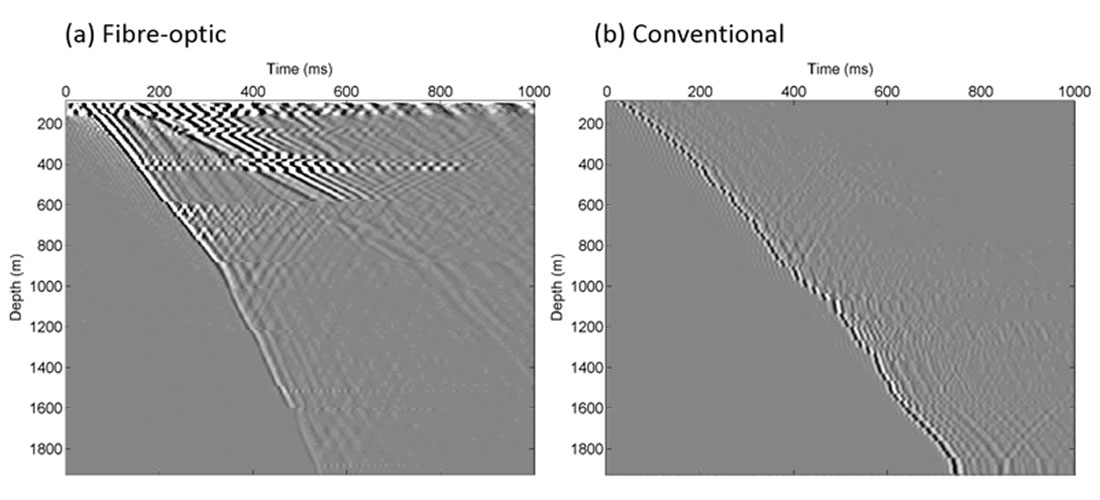
Wavefield separation and statics. F-K down-/up-going separation is used to preserve PP paths, with first-pass model-based statics from a 1-D velocity background constrained by robust direct-arrival misfit statistics to enhance voxel-scale repeatability.
Imaging and DAS directivity. Kirchhoff (or equivalent) migration is applied with cosine-squared DAS directivity correction; in gently structured settings a 1-D isotropic velocity model is adequate initially, with progressive refinement via anisotropy parameters and multi-well focusing, alongside uncertainty quantification.
4D differencing and attributes. Difference volumes are formed for M1–M0, M2–M0 and M2–M1 combinations, from which layer-constrained time-lapse attributes (e.g., RMS amplitude/energy) are extracted to produce time-sequenced plume maps and leading-edge tracking.
Interpretation and MRV
Multi-well geometry yields complementary illumination and mitigates DAS directivity effects, so that voxel-level fusion improves three-dimensional plume morphology and migration-path certainty; under gas-saturated backgrounds, small reflectivity changes are cross-validated between multi-well 4D differences and continuous offset-VSP, enabling discrimination between UGS cycling behaviour and re-activation of legacy CO₂ plumes; finally, 4D attributes are integrated with injection/withdrawal volumes, well/field pressures and rock-physics priors to assemble conformance/containment packs suitable for regulatory MRV, with the continuous channel improving temporal resolution and early-signal detectability.
Deliverables
A multi-epoch 3-D voxel model of the plume with uncertainty envelopes, leading-edge isochrons, layer-specific difference-attribute maps and volumes; combined well–surface sections for communication pathways, event replays and source–model fit reports; and an MRV-ready dossier including repeatability metrics (e.g., NRMS), QC summaries and tests of statistical significance for observed differences.
Value
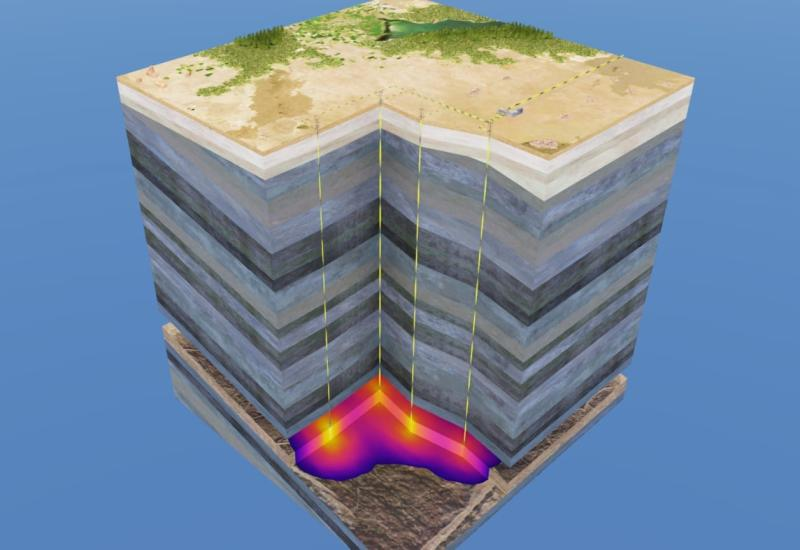
Compared with conventional surface 4D, DAS-VSP offers lower operational disturbance and cost at markedly higher repeatability—supporting more frequent “snapshots” through the injection and stabilisation phases—while, for small targets and limited illumination, the combination of denser source grids, monitor–baseline matching filters and multi-well fusion yields detectable, interpretable time-lapse signals that secure migration-path mapping (including up-dip movement along structure); used in tandem with continuous DAS/SOV, the programme delivers high spatial resolution from the repeat VSP and high temporal resolution from the continuous channel, bringing forward deviation detection and shortening the response loop.
Technical KPIs
(1) Repeatability: material reductions in monitor–baseline NRMS after matching-filter application; (2) Detection sensitivity: statistically significant amplitude and phase changes at target horizons; (3) Spatial resolution: improved 3-D plume coherence and edge crispness after multi-well fusion; (4) Temporal consistency: cross-method agreement between 4D-VSP and continuous offset-VSP on plume extent and evolution timing.
Risks and mitigations
Near-surface variability inducing wavelet drift is controlled by deterministic deconvolution and Wiener matching; DAS directivity and anisotropy impacts are reduced via explicit directivity correction, multi-well imaging and progressive introduction of anisotropic velocity models; interrogator changes are managed by cross-instrument amplitude–phase calibration; small targets and marginal illumination are countered by source densification and, where warranted, the addition of continuous SOV to improve temporal sampling.
Integration and extension
Time-lapse attributes are linked to pressure–saturation rock physics and geological modelling to estimate plume volume and movable phase; in UGS, cycle- and season-scale migration patterns are forecast and reconciled, while in CCUS the workflow ties directly to storage-unit integrity assessments and caprock reactivation risk, ensuring that surveillance outputs remain anchored to stratigraphic architecture, structural fabric and seal behaviour throughout the asset life.

 Prev
Prev
 Next
Next
 To list